Place Name:
Yuigahama (由比ガ浜)
The area called Yuigahama came into being after rezoning took place between 1964 and 1965. Originally part of Zaimokuza, Omachi, and Hase, it was named after nearby Yuigahama Kaigan Beach, although the origin of the word Yuigahama itself is not clear and different opinions exist.
One says that the "yui" in Yuigahama means "to help each other." Another says that the area once belonged to Yui-go (由比郷), consequently comes this name.
In olden times, yui (由井) was also written 湯井.
On the other hand, in a written record from the Kamakura period (1185/92-1333), the word, Maehama (前浜), was also used for this same area.
Sasame-cho (笹目町)
The Sasame-cho area was also created by rezoning and once was part of Omachi. The name probably derives from the place name, Sasamegayatsu (笹目ケ谷 or 佐々目ケ谷), which had existed in this area from olden times.
| Roku Jizo (六地蔵) |

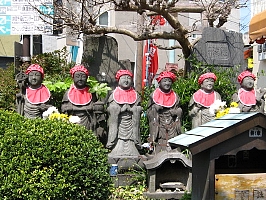
As you walk along the street that runs in front of Onari Elementary School (御成小学校) toward Yuigahama, you will reach Yuigahama-odori Avenue. On the left at the crossing, you will find a set of six stone statues of Jizo with red bibs around their necks, standing on pedestals on raised ground and surrounded by a low stone fence.
These six statues are called Roku Jizo--roku meaning six in Japanese--hence the name of this area.
It is said that in the Kamakura period there used to be an execution site slightly to the north of here. Later, the field was left uncultivated and called Kekachibatake (飢渇畠), "Starving-Field."
In time, the local people dedicated six Jizo here for the repose of the souls of the dead or executed. A stone marker explaining the origin of these Roku Jizo stands nearby.
The origin of Roku Jizo themselves, however, is beset with theories. The most probable one is that they are six manifestations of Jizo, each active in one of the six worlds where Jizo helps suffering people gain salvation.
The six worlds are the realms of hell (地獄), hungry spirits (餓鬼), animals (畜生), bellicose spirits (阿修羅), human beings (人間), and heaven (天). The souls of sentient beings are believed to transmigrate from one world to another.
Next to the Roku Jizo here is a small structure dedicated to Roku Jizo Inari (六地蔵稲荷).
| Wadazuka (和田塚) |
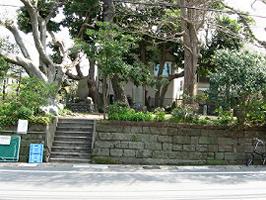
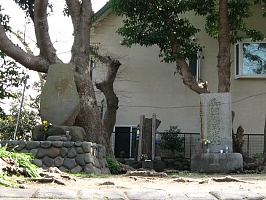
Soon after walking out of Wadazuka Station on the Enoden Line heading toward the beach, you will see a raised ground to the left dotted with old trees and surrounded by stone walls.
Within the grounds are some twenty stone stupas in gorinto-type (五輪塔) and a stone monument in the center.
This mound is popularly called Wadazuka, the "Wada Mound," since it is said to be the graveyard where members of the Wada clan (和田), influential vassals of the Kamakura period, were buried. More exactly, the mound was once called Mujodozuka (無常堂塚) and was one of the ancient burial mounds called Mukaibara Kofungun (向原古墳群, a cluster of Mukaihara Burial Mounds), which belonged to the Tumulus period (the third to seventh centuries).
When the mound was excavated in the Meiji period (1867-1912) due to road construction, many human bones were found buried together with haniwa (埴輪, tumulus figures) and fragments of earthenware. At the time, the bones were thought to be those of the Wada, who had fought against the Hojo (北条) and were defeated near here. It is from that time that the mound came to be called Wadazuka. Since this is the only tumulus mound that remains in Kamakura, it is thought to be very precious.
Wada Yoshimori (和田義盛, 1147-1213), a grandson of Miura Yoshiaki (三浦義明, 1092-1180) and military leader in the early part of the Kamakura period, pledged allegiance to Minamoto no Yoritomo (源頼朝, 1147-99) in the latter's uprising against the Taira (平) in 1180. Rewarded with the post of Administrator (別当, betto) of the Board of Retainers (Samuraidokoro, 侍所) for his help, Yoshimori became so influential that after the death of Yoritomo, the Hojo came to fear his popularity among the vassals of other clans and concocted a scheme to provoke Yoshimori into revolt.
When Yoshimori's sons and his relatives were arrested on charges of plotting against the Hojo, Yoshimori came all the way from Chiba and begged Shogun Minamoto no Sanetomo (源実朝, 1192-1219) to pardon them. This was done for his sons but one of his relatives was sent into exile. Angered at this decision, Yoshimori, with his sons and followers, attacked the residence of the Hojo.
The battle was fought everywhere in the city, continued for two days, and is known as Wada Gassen (和田合戦), "the Battle of the Wada." Although they put up a stiff resistance, the Wada were defeated near here and destroyed, having fallen into a trap set by the Hojo in the latter's process of dictatorship.
Diagonally across from the Wada Mound is the Kamakura-bori Kogeikan (鎌倉彫工芸館), where some one hundred Kamakura-bori works are on display: wooden boxes, bowls, trays, plates, hand mirrors, and so forth. The hall is open to public view and the articles are for sale or can be ordered. Videotapes in Japanese that show the carving and lacquering processes of Kamakura-bori can be watched on the premises.
|
The Former Site of the Residence of Someya Tokitada (染谷時忠屋敷跡) |
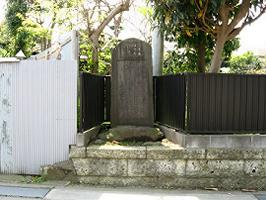
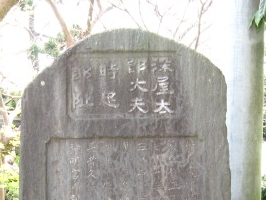
The monument, which marks this site, stands 150 meters from Yuigahama-odori on the street running in front of Yuigahama Station.
The explanation on the monument tells us that Tokitada was a descendant of Fujiwara no Kamatari (藤原鎌足, 614-669) and father of Ryoben (良弁), the priest who promoted the founding of Todaiji Temple in Nara.
Tokitada lived in Kamakura from the end of the seventh to the early eighth centuries. As a kind of constable, he oversaw the eight provinces of the Kanto region. He is said to have been very rich but, according to legend, his daughter met a tragic death. (See below)
| To no Tsuji (塔の辻) |
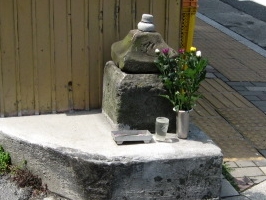
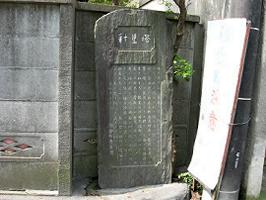
The area called To no Tsuji is located where the lane running from Sasuke crosses Yuigahama-odori. It got its name from the fact that there was a to (塔, pagoda) at the tsuji (辻, crossroads).
In olden days, it was customary to set stone monuments at crossroads. As might be expected, there are two stone stupas here. They are topped by red caps, as if they were stone figures, and offerings of flowers are made.
A local legend has it that one day the three-year-old daughter of Someya Tokitada was carried off by an eagle. Tokitada and his wife desperately sought for their lost child and wherever they found a part of her body, they erected a stone stupa. The stupa here is said to have been one of those erected in memory of their daughter.
A stone monument marking this tragedy now stands on the side of the lane leading toward Sasuke (佐助).
| Ichi no Torii (一の鳥居) |
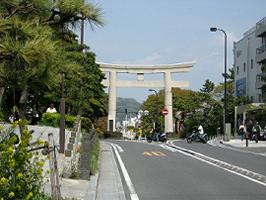
Ichi no Torii, the "First Shrine Gate," towers above Wakamiya-oji Avenue midway to the beach from Geba Yotsukado Crossing. This is the first gateway in the approach to Hachimangu Shrine and is also called Hama no Otorii (浜の大鳥居).
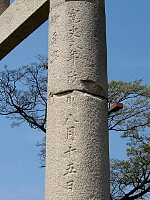
Originally erected in 1180, the present Ichi no Torii was rebuilt as a contribution of the fourth shogun, Tokugawa Ietsuna (徳川家綱, 1641-80), in 1668. The height is 8.5 meters and the width of the horizontal bar at the top is 13 meters. The characters, 寛文八年 (corresponding to 1668), are inscribed on one of the columns, and the entire structure is designated an Important Cultural Property.
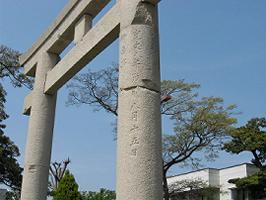
A story about this torii refers to a time when a lady of high rank named Sugen'in (崇源院), a wife of the second shogun, Tokugawa Hidetada (徳川秀忠, 1605-23), desired to have a child of her own.
As a devotee of Benzaiten in Tsurugaoka Hachimangu, she prayed to the deity, and, it is said, her hopes were soon answered: the birth of Iemitsu (家光, 1604-51), who later became the third shogun.
On another occasion, Benzaiten appeared to her in a dream, saying, "Replace the present wooden torii with one of stone. Materials will be found in Bizen (備前, present-day Okayama Prefecture)." Sugen'in immediately dispatched a party to search for the stones and, upon their return, was given a good report.
The undertaking, however, was so difficult that it was not until the time of Shogun Ietsuna that the construction of the torii was completed. Thus, Sugen'in never saw the completed work.
The torii collapsed in the Great Kanto Earthquake of 1923, but was restored four years later. Nowadays we cannot look up at this imposing torii without thinking of the great efforts that were expended in carrying such large and heavy stones all the way from Bizen and erecting them into a torii.
| The Tomb of Hatakeyama Shigeyasu (畠山重保の墓) |
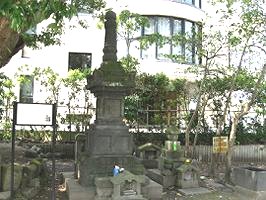
The grave is situated under a tall old tree called tabu no ki (タブの木, Machilus thunbergii) on the right of the roadside near Ichi no Torii.
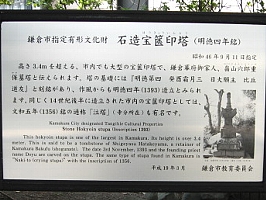
The tombstone, in hokyointo-type (宝篋印塔), is 3.4 meters high and bears the inscription 明徳四年 (corresponding to 1393). This stone stupa is supposed to have been made in the Muromachi period (1336-1573) and is designated an Important Art Object by Kamakura City. The relationship between this tombstone and Hatakeyama Shigeyasu (畠山重保, ?-1205), who was a warrior in the Kamakura period, is not clear.
A story concerning him is that his father, Hatakeyama Shigetada (畠山重忠, 1164-1205), was a well-known warrior in the early part of the Kamakura period. Shigetada fought against Yoritomo in the initial stage of the war between the Minamoto (源) and Taira.
Shigetada, however, yielded to Yoritomo and thereafter played an active role in the battles that followed. He was not only brave as a warrior but also merciful and possessed a high artistic sense.
When Shigetada (and other warriors), for example, had to descend a precipitous slope on horseback to make a sudden attack on the enemy, only Shigetada went down, carrying his cherished horse on his back for fear it might be injured.
He is also said to have played a musical instrument while Shizuka Gozen (静御前), Minamoto no Yoshitsune's (源義経, 1159-1189) mistress, danced in the presence of Yoritomo and his wife Masako (政子, 11157-1225) in the grounds of Hachimangu Shrine.
Shigetada's son, Shigeyasu, was as brave as his father, but was said to have suffered from chronic asthma attacks.
After the death of Yoritomo, the Hojo began to gain control of the government. Shigetada, becoming so influential, came to be seen as a rival to the Hojo. It was in such circumstances that Hiraga Tomomasa (平賀朝雅), a son-in-law of Tokimasa's second wife, attempted to entrap the Hatakeyama, spreading rumors that they were against the Hojo.
Believing the slander, Hojo Tokimasa (北条時政, 1138-1215) ordered his son, Yoshitoki (北条義時, 1163-1224), to attack the Hatakeyama. Shigeyasu, we are told, was killed on Yuigahama Beach while suffering from an attack of asthma, showing that even a brave warrior could not overcome an illness.
Meanwhile, his father, Shigetada, was also defeated, and killed, in Futamatagawa (二俣川, in present-day Yokohama) on the same day by the army of Yasutoki.
The spot where Shigeyasu's tombstone stands was reportedly part of the estate of Hatakeyama Shigeyasu.
Even today, there are local people who, when they suffer from coughing, pray to Rokuro-sama (六郎様), the honorific name for Shigeyasu, for recovery, and when well, customarily make an offering of a cup of tea or other appropriate items. Thus, a cluster of flowers, a cup of tea, and incense sticks are often set out in front of the tombstone.
| Biwa-koji Street and Biwabashi Bridge (琵琶小路と琵琶橋) |
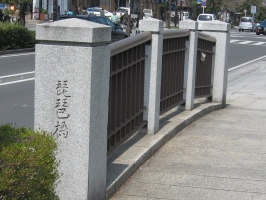
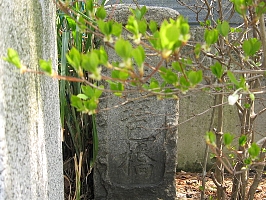
The street running between the crossing at the Roku Jizo and Wakamiya-oji Avenue (若宮大路) is now called Biwa-koji, although records from the Edo period (1603-1867) show the same name was used for part of Wakamiya-oji between Ichi no Torii and Ni no Torii (二の鳥居).
The "biwa" in the name of the street derives from the four-stringed Japanese lute, called biwa (琵琶), held by Benzaiten (弁才天), whose shrine was once located nearby.
Biwabashi Bridge is only a few steps south of Geba Yotsukado Intersection (下馬四つ角) and was one of ten famous bridges in old Kamakura. Until 1955, it was a vermilion wooden bridge with ornamental railing tops on either side, but it has since been replaced by the concrete one you see today.
| The Former Site of Hama no Torii (浜の鳥居跡) |
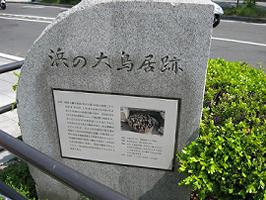
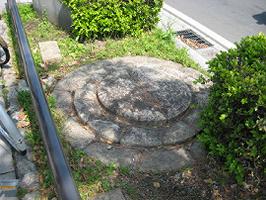
The flat stones laid out in a circle 1.6 meters in diameter, diagonally across the street in front of Kamakura Jogakuin (鎌倉女学院), mark the site where one leg of a huge torii pillar once stood.
The bottom section of the pillar, 1.6 meters in diameter, was discovered in 1990 when construction for an underground cable was undertaken. Judging from the finding, the torii (originally erected in 1180) is thought to have been built in 1553 when Kamakura was under the rule of Hojo Ujiyasu (北条氏康), who is said to have brought the Hojo clan of Odawara (小田原) to its highest level of prosperity.
| Kaigambashi Bridge (海岸橋) |
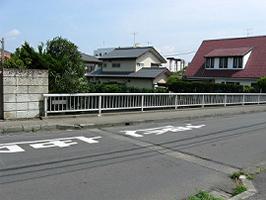
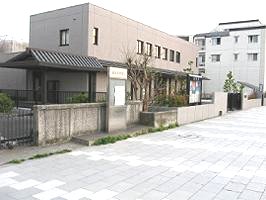
The Kaigambashi Bridge spans the Namerigawa River (滑川) on the way to Kuhonji Temple (九品寺) from the crossroads some 200 meters south of Ichi no Torii.
In the Kamakura period, this area was used as a training ground for military arts, and battles were fought here.
One was in 1205 between the Hatakeyama and Hojo, in which Hatakeyama Shigeyasu was killed. Another was in 1213 between the Wada and Hojo.
In 1953, a number of human and horse bones were excavated at the present site of the Kamakura Summery Court (簡易裁判所). Judging from the unearthed porcelain excavated at the same time, it is presumed that the bones belonged to the Kamakura period, and because of their large number, nearly one thousand, that many were from casualties in the battle between Nitta Yoshisada's (新田義貞, 1301-38) forces and those of the Hojo in 1333.
| Yuigahama Beach (由比ガ浜海岸) |
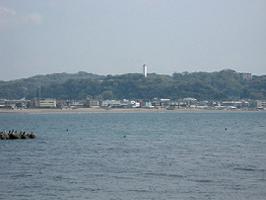
Yuigahama Kaigan Beach is reached by walking south on Wakamiya-oji Avenue.
The name Yuigahama was once used for the area extending from Inamuragasaki Point to Iijima in Zaimokuza, but now it is only for the area between the Inasegawa (稲瀬川) and Namerigawa Rivers.
In 1880, Dr. Erwin Von Belz (1849-1913), a German physician and resident of Japan from 1876 to 1905, visited Kamakura and recognized it as an ideal health resort.
Furthermore, in 1884, Dr. Nagayo Sensai (長与専斎, 1838-1902), a medical scientist and president of Tokyo Igakko (東京医学校, the predecessor of the Medical Faculty of Tokyo University) from 1875 to 1878, asserted that Kamakura was an ideal bathing resort. His statement made Kamakura famous as a summer resort across the country.
The beach witnessed numerous historical events and incidents.
In the Kamakura period, for example, Yuigahama was called Maehama (前浜) and was used as a field for such martial arts as kogasagake (小笠懸).
Also, when a shogun traveled to Hakone and Izu to offer prayers, he would purify himself here with water dipped from the sea.
Furthermore, it is recorded that in 1193, Yoritomo set a crane free in a ceremony called hojoe (放生会), which is a memorial service for birds, fish, and animals that had to sacrifice their lives for human consumption. In the ceremony, living creatures are released into ponds, the sky, or woods.
Yuigahama was a battlefield long ago; in 1180, the battle between Miura Yoshizumi (三浦義澄, 1127-1200) and Hatakeyama Shigetada, and in 1333, the battle between Nitta Yoshisada and the defense forces of the Hojo, took place here.
Another story has it that in 1186, Adachi Shinzaburo (安達新三郎), a Yoritomo vassal, threw a baby boy into the sea here, under orders from Yoritomo. The baby's mother was 17-year-old Shizuka Gozen, mistress of Minamoto no Yoshitsune. She had been captured while she and Yoshitsune were trying to escape from a pursuing Yoritomo.
The two brothers, Yoritomo and Yoshitsune, had been hostile because Yoshitsune had accepted a high position at court in Kyoto without first consulting his elder brother, the de facto ruler of the country. Shizuka was sent to Kamakura with her mother, Iso no Zenni (磯の禅尼), and questioned about Yoshitsune's whereabouts.
She did not, however, yield to the interrogation, and eventually was pardoned. It was during this time that she was found to be pregnant. Yoritomo proclaimed that should it be a girl, Shizuka could take the baby back with her to Kyoto, but if a boy, his fate would be left to the authorities.
In spite of Shizuka's prayers for a girl, she gave birth to a boy. The boy was then killed as ordered. It is said that after that event, Shizuka returned to Kyoto and became a nun.
| Soga Brothers and Yuigahama Beach (曽我兄弟と由比ガ浜海岸) |
Their enemy was Kudo Suketsune (工藤祐経, ?-1193), one of Yoritomo's followers, who had killed the brothers' father, Ito Sukeyasu (伊東祐泰, ?-1176), and wounded their grandfather, Ito Sukechika (伊東祐親, ?-1182).
Actually Sukeyasu had accidentally been killed, as Suketsune's real target was Sukechika, who narrowly escaped with only a slight wound.
Suketsune had been accusing Sukechika of robbing him of his land. Unable to regain it, he harbored a grudge against Sukechika and waited for a chance to retaliate, which he eventually did by attacking him.
Later on, Suketsune served under Yoritomo and played an important role in the government. However, thoughts that the two brothers might seek revenge were never far from his mind. Thus, he asked Yoritomo for permission to execute the two brothers.
At the Yuigahama execution site, a large number of people gathered to see the two brothers meet their doom. Already reconciled to their fate, the two brothers sat calmly, their eyes closed, their hands folded.
When asked for their last words, the elder one said, "Please tell our mother that we were executed in dignified manner." Faced with such an attitude, Kajiwara Kagetoki (梶原景時, ?-1200), the executioner, could not carry out his duty and asked Yoritomo to pardon the brothers.
Yoritomo replied, "You, Kagetoki, saved me in the battle of Mt. Ishibashi (石橋山) when I was cornered and narrowly escaped certain death." (Yoritomo was referring here to the time when Kagetoki, although a warrior on the Taira side, pretended not to see Yoritomo, who had hidden himself in a cave.) Yoritomo continued, "You are truly a person who saved my life. But that is one thing and your request is another." Other important vassals, including Wada Yoshimori and Chiba Tsunetane (千葉常胤, 1118-1201) asked Yoritomo in turn to pardon the two. But their pleas angered Yoritomo all the more.
Finally, Hatakeyama Shigetada was able to persuade Yoritomo, saying that governing the people should depend not only on power but also on a sense of humanity.
In the end, Yoritomo relented and said, "Let today's execution be stopped, and put the two under the charge of all in attendance here." Immediately there were shouts of joy and all prostrated themselves in front of Yoritomo. The brothers were then sent back to Soga.
Eleven years later, in 1193, the brothers took vengeance on Kudo Suketsune while he was hunting in the fields at the foot of Mt. Fuji. Soga no Juro Sukenari (曽我十郎祐成) and Soga no Goro Tokimune (曽我五郎時致) were 22 and 20 years old, respectively.
Their story has been dramatized in many plays as a good example of filial piety and their names have long been remembered.
|
The Monument to Gyoran Kanzeon and The Monument for the Centennial of the Opening of the Beach (魚籃観世音碑) と (由比ガ浜海水浴場百年記念碑) |
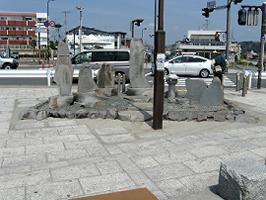
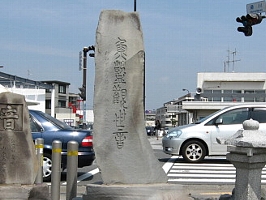
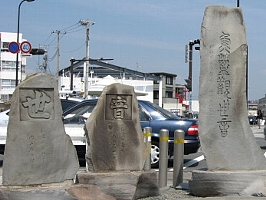
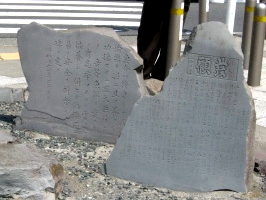
When you cross Route 134 (also called Shonan-doro, 湘南道路) at the beach end of Wakamiya-oji Avenue, you will see six stone monuments dedicated to Gyoran Kanzeon, one of the 33 manifestations of Kannon (観音) that usually shows her holding a fishing basket or riding atop a large fish. The monuments were built in 1966 by Yamamoto Shoichi (山本正一, the then mayor of Kamakura).
The inscription to the right says, "This monument was erected for the safety of women divers and to the memory of all the fish that sacrificed their lives for us."
The characters, 魚籃観世音, Gyoran Kanzeon, on the tallest one are written in a somewhat different style called tensho (篆書), or seal script, by Nishikawa Gozan (西川五山), a calligrapher. The character, 観, on the left one was written by Sato Eisaku (佐藤栄作), a former prime minister, and 世on the second one from the left was by Uchiyama Iwataro (内山岩太郎, a former governor of Kanagawa Prefecture) and 音on the third one was by Yamamoto himself.
Some stones in the shape of seashell, lobster, and fish are seen in front of the monuments.
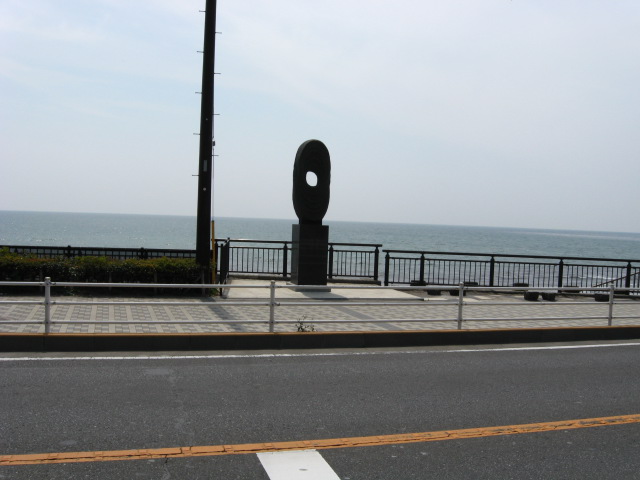
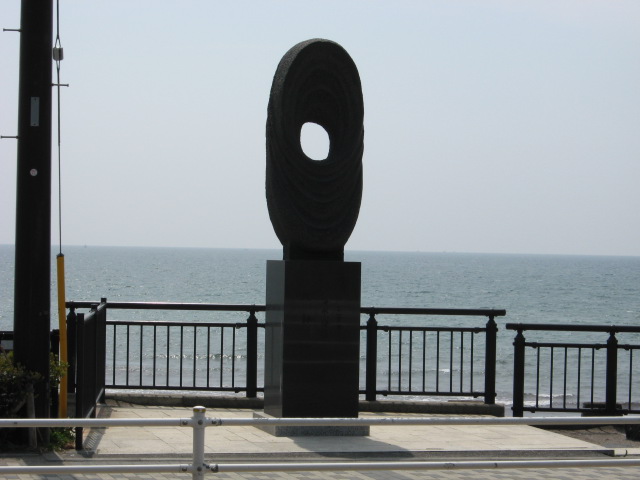
A monument some 200 meters west on the roadside was built in 1988 to commemorate "The centennial of the Opening of the Beach." The inscription reads 波動 (hado), "Wave Motion", and the monument itself is an abstract expression of a motion of waves.
The other inscription on the same monument says, "The beaches of Kamakura have been widely known since 1880, when they were first recommended by Dr. Nagayo Sensai as an ideal bathing place to promote ones health. It is our hope that the beaches, which offer different features in each season, will always attract and be cherished by many people."
| Kamakura Kaihin Koen or Kamakura Beach Side Park (鎌倉海浜公園) |
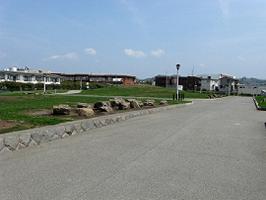
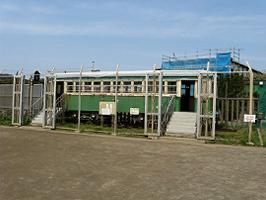
On the north side of Route 134 is a park named Kamakura Kaihin Koen. This 21,000-square-meter park was completed in 1988. A fine view of the bay can be had from atop the mound within.
There is also a "retired" street car, popularly called Tankoro (タンコロ), on display. It ran for 50 years on the Enoden Line, after which it was donated to the city. Visitor can board it and enjoy sitting in an old-time atmosphere.
| The Inasegawa River (稲瀬川) |
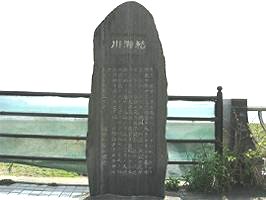
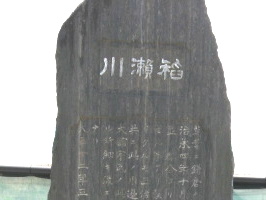
The Inasegawa River runs between Yuigahama and Sakanoshita, forming a border for the two areas. Though it is narrow and nondescript today, it seems to have been wider in olden times.
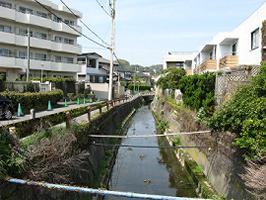 The river witnessed a number of historical events and incidences. When, for example, Yoritomo set up his residence in Kamakura in 1180, his wife, Masako, journeyed here from Izu. But, because of tradition, she had to accommodate herself in a house on the outer bank of the river to await an auspicious day. In those days, the river was wide enough to function as the western border of Kamakura.
It was from here, in 1184, that Minamoto no Yoritomo saw off the troops of Noriyori (範頼, ?-1193), his brother, on their way to campaign against the Taira clan in the western part of Japan.
In the following year, Yoritomo is said to have received the long-awaited remains of his father, Yoshitomo (義朝, 1123-1160), at the mouth of this river.
In 1333, before the collapse of the Kamakura government, the army of Nitta and that of the Hojo fought a fierce battle here. Odachi (or Otachi) Muneuji (大館宗氏), a general of the Nitta forces, was killed and the rest of his army had to retreat to Gokurakuji. Afterwards, Nitta's forces rearranged their position and attacked the city via the Inamuragasaki Cape.