| Gokurakujizaka Kiridoshi Pass (極楽寺坂切通し) |
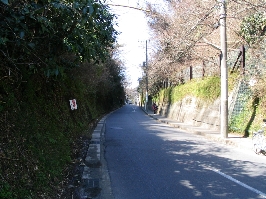 The pass, which begins from around Hoshizuki no I Well, is called Gokurakuji-kiridoshi Pass, or Gokurakujizaka Slope, which Ninsho (忍性, 1217-1303), a priest of Gokurakuji Temple, is said to have opened. In the Kamakura period the slope ran as high as the lane which now runs in front of Jojuin on the hillside. Steep and narrow in those days, it nevertheless was one of the seven old passes giving access to Kamakura and played an important role as a main road to and from Kyoto, via Shichirigahama Beach and Fujisawa. In those days, people suffering from diseases also passed here along with warriors, monks, merchants, and travelers, because Gokurakuji Temple functioned as a sanatorium. This road was strategically important to the military Kamakura government. Hojo Shigetoki (北条重時, 1198-1261) had Gokurakuji Temple built, took the tonsure and spent his later years here. The temple also functioned as a defense facility, because the area was politically and militarily important. The Hojo placed the road under their control and were able to close it completely whenever threatening events warranted doing so.
The area is widely known as the site of a fierce battle between the imperial forces led by Nitta Yoshisada (新田義貞 1301-38) and those of the Hojo. According to the Taiheiki chronicle (太平記), when Nitta's forces attacked Kamakura in 1333, some 10,000 troops led by Odachi (or Otachi) Muneuji (大館宗氏), one of Yoshisada's generals, were positioned here. At one point his forces overwhelmed the Hojo side, but were thrown back and lost many soldiers. Among them were Odachi Muneuji himself and his relatives. On hearing of the defeat, Yoshisada rushed here, but eventually gave up trying to break through the defenses when he saw in the moonlight tens of thousands of enemy soldiers manning the strongholds that had been built everywhere on the hillsides on either side of the pass. Switching tactics, Yoshisada then decided to enter Kamakura via Inamuragasaki Point.
Today not a single trace of the battle can be seen, and the mildly sloping road provides visitors with an easy access to Gokurakuji Temple.
| Higiri Jizo (日限地蔵) |
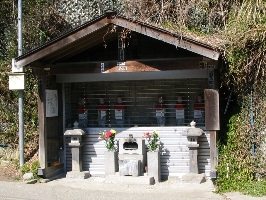 On the right side of the Gokurakuji-kiridoshi Pass are six statues of Jizo, who keep guard against traffic accidents within their sight. They came to be called Higiri Jizo, "Time-Limiting Jizo," because those who visit and pray on fixed dates will have their prayers answered.
| Jojuin Temple (成就院) |
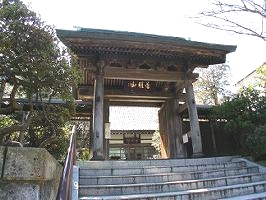 Full Name: Fumyosan (普明山) Jojuin
Denomination: Shingon sect of Buddhism
Location: on Gokurakujizaka Slope between Hase and Gokurakuji.
History: The founder of the Shingon sect, Kobo Daishi (774-835), came here during a pilgrimage to various parts of the country and conducted Buddhist rites to obtain wisdom from Kokuzo Bosatsu. The mystic atmosphere of those rites so impressed the local people that they are said to have been able to live peacefully thereafter and enjoy abundant crops. This sacred place, however, was abandoned for a long time. Then, in 1219, Hojo Yasutoki (北条泰時, 1183-1242), the third regent, invited the priest Shinsai (辰斎) and had this temple built to guard the entrance to Kamakura and to ensure the prosperity of the Hojo family. After the halls burned down in a battle between the Nitta and the Hojo in 1333, the temple was temporarily re-established in another location, then was rebuilt here in the Edo period and remains as it is to this day.
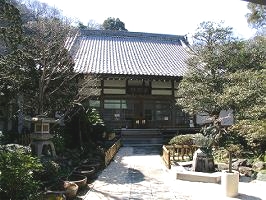
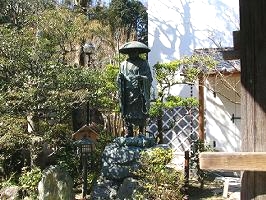
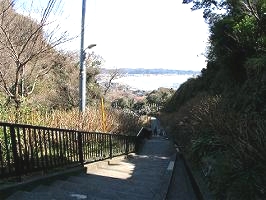
Grounds: A flight of stone steps lined with hydrangea (ajisai, アジサイ, which bloom in early summer), goes up the hillside. At the top is a fine view of Yuigahama and Zaimokuza Beaches below. Within the grounds and to the right is a statue of Kobo Daishi (弘法大師, 774-835), and behind a neatly arranged garden is the Main Hall, which, though closed to the public, houses statues of Fudo Myoo (不動明王), Senju Kannon (千手観音), Dainichi Nyorai (大日如来), Jizo Bosatsu (地蔵菩薩), and Kobo Daishi.
 The temple has a sculptured statue of Mongaku (文覚, 1139-1203), a priest of the Shingon sect, who was close to Minamoto no Yoritomo and helped him rise against the Taira. The statue depicts Mongaku in austere religious practice. Ogiwara Morie (荻原守衛, 1879-1910), a sculptor who had studied Rodin's technique in France and was responsible for the establishment of modern sculpture in Japan, was so moved and inspired by this image that he carved a statue, naming it Mongaku. The statue was awarded a prize in the Ministry of Education's Fine Arts Exhibition (Bunten,文展), that began in 1907 and lasted until 1918. The statue is now on display in the Rokuzan Art Museum (碌山美術館) in Hodaka-machi (穂高町), Nagano Prefecture.
| Grave of Uesugi Norikata (上杉憲方の墓) |
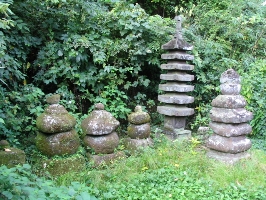
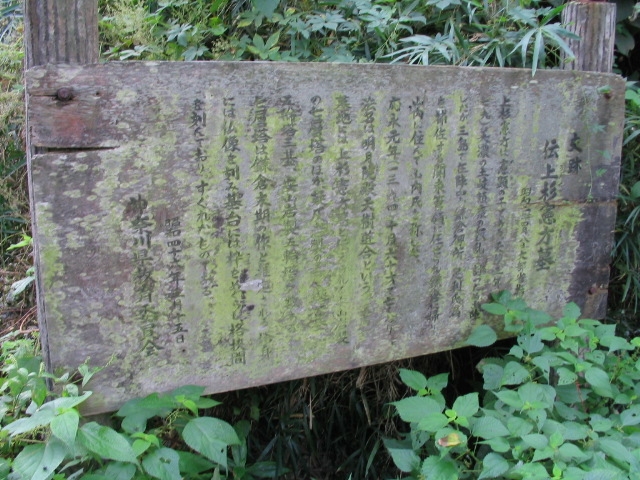
The grave is situated close to Sakurabashi Bridge (桜橋), at the top of Gokurakujizaka Slope. A small stone marker inscribed "Uesugi Norikata no Haka" (上杉憲方の墓 Uesugi Norikata Gravestone) stands at the entrance of a narrow pathway. From there the site is only a few steps down the path and on the left.
A gorinto-type stupa (五輪塔) and a tasoto-type stupa (多層塔) are located in a small space at the foot of a cliff. The latter stupa is a seven-roofed structure with a relief on each of its four surfaces of the four Buddhas of the Diamond Realm (Kongokai, 金剛界). This stupa is said to be dedicated to Uesugi Norikata, while the gorinto stupa is for his wife. Uesugi Norikata (1335-94) came from the Yamanouchi Uesugi (山ノ内上杉) and served as Kanto Kanrei (管領 commander) for Ashikaga Ujimitsu (足利氏満、1359-98), the Kamakura Kubo (公方). Later on, he handed over his position to his son, Uesugi Noritaka (上杉憲孝, ?-?), and entered the priesthood under the name Meigetsuin Tenju Dogo (明月院天樹道合). He is remembered as the founder of Meigetsuin Temple (明月院) in Yamanouchi, which is popularly known as Ajisaidera, "Hydrangea Temple."
| Gokurakuji Temple (極楽寺) |
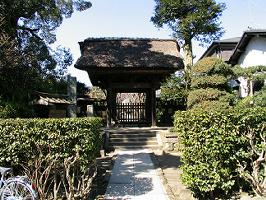 Full name: Ryojuzan (霊鷲山) Gokurakuji
Denomination:Shingon Ritsu sect (真言律宗) of Buddhism
Location: Immediately north of Gokurakuji Station on the Enoden Line.
History: In 1259 Hojo Shigetoki (北条重時, 1198-1261) initiated the construction of Gokurakuji Temple in a valley called Jigokudani (地獄谷 Hell Valley), in cooperation with Ninsho (忍性, 1217-1303), a disciple of Eison (叡尊, 1201-90). When Shigetoki died before it was finished, his sons Nagatoki (長時, 1229-64) and Naritoki (業時, 1241-87), saw to its completion. After Ninsho was installed as its first priest, the temple eventually became one of the major ones in Kamakura.
The present appearance of Gokurakuji Temple belies its former scale and grandeur. As depicted in a drawing handed down for generations in the temple, it once had a double-roofed Golden Hall and a thirteen-storied pagoda. Shown, too, are seven major halls and 49 attached buildings. Its pagoda was reportedly so high that it could be seen from a far distance.
In 1333, when Kamakura was attacked by the Nitta forces, the temple was burned to the ground. Though it was afterwards rebuilt, several later fires, earthquakes, and storms consumed it completely. Now, only Kisshoin (吉祥院) remains as the Main Hall. Most of the temple's former grounds now make up Inamuragasaki Elementary School (稲村ケ崎小学校) and a residential area.
Excavation underscores what has been told of the temple's former glory. Among the many remains unearthed are celadon porcelain, tea ceremony utensils, incense burners, and roof tiles with the Hojo family crest (three stylized fish scales). The remains of the lowest part of the temple walls, some foundation stones for a gate and a pagoda, and other remains of foundation stones for large-scale buildings have been uncovered from beneath layers of ash.
Story (1): The Singon Ritsu sect of Buddhism
Gokurakuji Temple now belongs to the Shingon Ritsu, a sect not so familiar in Kamakura. The sect became independent of the Shingon sect (真言宗) in 1895, with Saidaiji Temple (西大寺) in Nara serving as its head temple. Eison, the restoring founder of Saidaiji, is now regarded and revered as the founder of this sect.
Around the 13th century, the activities of such newly-born sects of Buddhism as Jodo (浄土), Nichiren (日蓮), and Zen (禅) became noticeable. Also, their teachings were simple enough to be accepted by the warrior class and even by commoners. Under such circumstances, some priests began to realize that the doctrines and activities of the established sects were being hampered by tradition. Eison, one of these priests, originally of the Shingon sect, strove to revive the teachings of Shakyamuni himself and the rules of discipline that had been set forth for monks and nuns in his day. People, he asserted, should strictly observe Shakyamuni's original words and lead their lives accordingly. This, he said, would be the best approach to the state of Buddhahood or nirvana.
Though Eison was mainly active in the western part of the country, he once came to Kamakura at the invitation of the Hojo and was received enthusiastically not only by that family but also by high-ranking retainers.
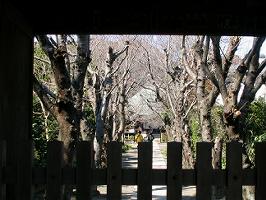 Grounds: Beyond the thatched Sammon Gate is the approach to the Main Hall, lined with cherry trees. On the right of the Main Hall are Taishido Hall (大師堂) and Temporinden Hall (天法輪殿), used as a Treasure Hall. On the opposite side are a Kyakuden (客殿), or Guest Hall, and Kuri (庫裏), a priest's living quarters.
In the garden is a rare cherry tree that bears both single and double blossoms in spring. In summer, tall crape myrtle with their extended branches come into full red bloom.
Temporinden Hall (open only on Saturdays and Sundays) houses many cultural assets related to Shakyamuni. The main image, a standing image of Shaka Nyorai (釈迦如来), is open to the public on April 7, 8 and 9 only. The statue, in Seiryoji-style (清凉寺), is a copy of one at Seiryoji Temple (清凉寺) in Kyoto. (The style was introduced from India through China.) The carved wooden statue is distinguished by the straight, symmetrical lines of the robe, and projects the simple, dignified impression that would be expected of Shakyamuni himself.
There are also statues of the ten great disciples of Shakyamuni, which have their own distinguishing features, yet are harmonious overall. A seated wooden image of Eishin (栄真), the second head priest of Gokurakuji Temple, is carved so that the robe expands in the lower part, a distinctive feature of sculptures in the Shingon Ritsu sect.
Also on display are a gokorei (五鈷鈴, a bell with a five-pronged handle) and a gokosho (五鈷杵, a pounder with a five-pronged handle), said to have belonged to Ninsho, (忍性 1217-1303), the first priest, though both are replicas. Some of the excavated objects and a photograph of an illustrated map of Gokurakuji are also on display, along with the main part of a battle drum said to have been used by Nitta Yoshisada when ordering troop movements during his attack on Kamakura. Portraits of Ninsho, Eison, and Ninsho's teacher Keisho (恵性) who revived the temple in the Edo period, together with images of Fudo Myoo (不動明王), Yakushi Nyorai (薬師如来), andMonju Bosatsu (文殊菩薩), are kept in the Main Hall, also known as Taishido Hall. They are not open to the public.
From the back gate, after passing a school playground, a lane leads to Okunoin (奥ノ院), a structure in the inner sanctuary, on the hillside. Ninsho's gorinto-type stupa (忍性の五輪塔) stands here, but is open to the public only on April 8th, Shakyamuni's birthday.
This imposing stone stupa, some 3.5 meters tall, is designated an Important Cultural Property. Immediately to the left is a hokyointo-type stupa, said to be that for Hojo Shigetoki, a son of the second regent Hojo Yoshitoki (北条義時 1163-1224).
A little further beyond is another stupa, this one for Junnin (順忍), the third head priest of Gokurakuji, which was once mistakenly thought to be the stupa for Ninko (忍公).
Story(2): Priest Ninsho and His Charitable Activities
Ninsho was a disciple of Eison (the founder of the Shingon Ritsu sect) and, from his early years, actively supported his master's missionary work of spreading the teachings of Shakyamuni himself.
In 1261, he came to Kamakura and lived at Gokurakuji as the first Chief Priest. He underwent ascetic practices to realize what Shakyamuni had taught. Determined to save all sufferers, he undertook social work and had a number of institutions built, including Seyakuin (施薬院), which provided free medicine to the poor; Hiden'in (悲田院) for orphans and helpless old people; and Ryoyoin (療養院) for the sick. Ninsho is said to have taken care of as many as 60,000 ill and deformed people over a 20-year period, and to have provided rice gruel in times of famine.
A large stone bowl for mixing medicinal ingredients (seiyaku-bachi, 製薬鉢), and a stone mortar for grinding medicinal materials (sempuku-chausu,千服茶臼), capable of churning out medication sufficient for, literally, a thousand sufferers, are kept within the grounds and attest to his activities.
At Sakanoshita, Ninsho even built a hospital for horses (indispensable for mounted warriors) and prayed for their recovery there. In addition, he repaired roads and dug wells, supposedly using many highly skilled civil engineers. Accordingly, he gained the respect of people from every walk of life. When he died at the age of 87, Emperor Go-Daigo (後醍醐天皇, 1288-1339) bestowed on him the title of bosatsu and Ninsho has ever since been remembered as a truly celebrated priest.
| Michibiki Jizo (導き地蔵) |
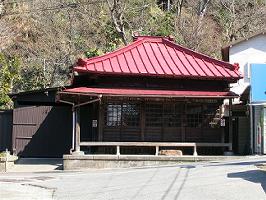
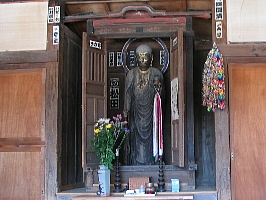
A structure that houses a Jizo statue stands close to both Gokurakuji Temple and Sakurabashi Bridge. Inside is Michibiki Jizo, "Guiding Jizo." The Jizo protects children from whatever impedes their smooth growth and prevents mishaps within his field of vision.
| Kumano Shingu Shrine (熊野新宮) |
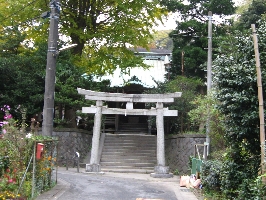
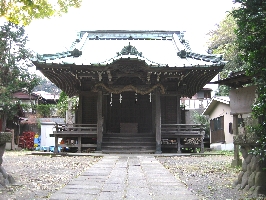
Location: Turn to the left in front of Michibiki Jizo, walk ahead a few minutes, then turn to the right at the first lane leading to the right and you will see a marker for three shrines: Kumano Shingu Shrine, Yakumo Jinja Shrine (八雲神社) and Suwa Jinja Shrine (諏訪神社). If you walk 100 meters along the lane, you will see a stone torii (鳥居) gate, and a Main Hall of the combined shrines which houses the deities.
History: Documnets on Priest Ninsho (1217-1303) -- a presiding priest of Gokurakuji Temple in the neighborhood -- state that he had the shrine built here in 1269. In those days this area was within the Gokurakuji Temple grounds.
Grounds: The Hall, with its tarnished-copper roof, was reconstructed in 1927. Next to it is a repository for a mikoshi (神輿), portable shrine. The absence of fences, the openness and the neatly arranged shrine grounds are all indications that the local people have preserved the shrine well.
The annual festivals, with their portable shrines and parade of floats are held by the local residents, who enjoy them as a summer season activity on the second Sunday of July for Yakumo Jinja, and September 8 for Kumano Shingu and Suwa Jinja.
| Tsukikage Jizo (月影地蔵) |
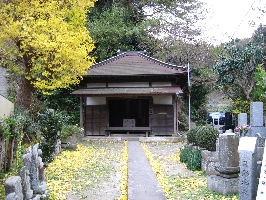
Location: Continue your walk, passing Inamuragasaki Elementary School, and you will reach a fork in the road. The left leads to Nishigayatsu Valley (西が谷) and the other runs parallel to the Gokurakujigawa River. If you follow the latter a little further, you will arrive at a point where the road forks again, and here you will see a stone marker for Tsukikage Jizo.
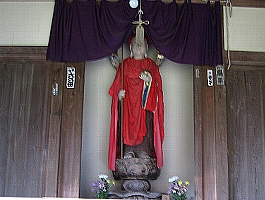
History and Grounds: The Jizo was transferred from Tsukikagegayatsu (月影ケ谷) long ago. The original Jizo, reportedly destroyed in a fire, was replaced by the present one, which looks rather new. The hall is open and accessible to everyone. This wooden Jizo has a round and gentle-looking face and wears a red robe and a hood, offerings by the local people.
The hall itself is adorned with sembazuru (千羽鶴), a thousand paper cranes. The Jizo is revered by nearby residents, who make it a custom to open and close the hall door every day.
| Babagayatsu Valley (馬場ケ谷), Hojo Tokimune (北条時宗), and Kasagake (笠懸) |
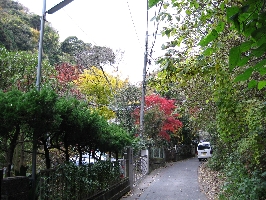
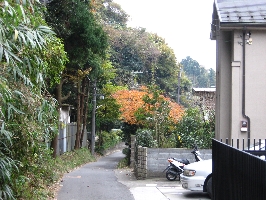
Location: Walk toward the Inamura Elementary School gym from Gokurakuji Temple, turn to the right, and you will be in a valley called Babagayatsu, narrow and lined with houses. The road rises steeply after it passes by some of the houses and leads to a filtration plant managed by the City Waterworks Bureau (市水道局).
History: Nowadays, no traces related to horses can be seen, but at one time there was a training ground here for horses recovering from sickness or injury.
It is said to have been built by Ninsho, and later used by warriors for horsemanship practice.
In the Kamakura period, warriors applied themselves to martial arts not only in this area but almost everywhere, with horsemanship being the most important. Yabusame (流鏑馬, mounted archery), kasagake (笠懸, hanging-hat or hat-hanging), and inuomono (犬追物, dog chasing) were particularly popular, and were held in the form of a ceremony or contest.
Kasagake is a form of mounted archery in which a bowman gallops his horse down a course and shoots an arrow at a target, a kind of contest to demonstrate one's skill, as in yabusame.
The target was originally a hat (笠, kasa) woven from a kind of reed, so this kind of archery was called kasagake. Later, however, the target was replaced by a Japanese cypress board 54 centimeters in diameter that was backed by a cowhide bag stuffed with cotton and a bull's-eye marked in black.
Three strings held the target in place and were attached to wooden poles in the shape of a torii, which was set up in front of a mound called azuchi (あずち). Kaburaya (鏑矢) arrows, with their round, hollow heads made of deer antlers, whistled sharply as they flew at the target.
The archer wore a costume simpler than that for yabusame: a hitatare (直垂) and mukabaki (行謄) and a short sword, but did not wear a hat.
A similar sport is kogasagake (小笠懸), differing in its target, which is supposed to be enemies waiting in ambush. Participants vied with one another in shooting at a small wooden target 12 centimeters square, placed as close as 24 centimeters to the lane and as low as 35 centimeters from the ground. Riders rode in a direction opposite to that for kasagake. With the target set closer and lower, the contest was made more difficult.
Legend: There is a legend connected with Babagayatsu Valley that goes back to the time when the sixth shogun, Munetaka (宗尊親王, 1242-74), the son of Emperor Go-Saga (後嵯峨天皇, 1220-72), visited here one day in company with the sixth regent, Hojo Nagatoki and the former regent, Hojo Tokiyori (北条時頼, 1227-63).
After practicing horsemanship, they engaged in kasagake, and then kogasagake. The presence of Prince Munetaka so unnerved the archers that no one could hit the target, and when he asked whether there was no man able to do so, everyone kept silent out of fear of losing face.
Presently, Tokiyori stepped forward and said, "If I may be so bold, Excellency, … my son, Tokimune (1251-84), is a fine marksman, highly skilled as an kogasagake archer. I am confident he will match your expectations." Tokiyori immediately sent for Tokimune, who was at his residence in Komachi.
Though only 11 years old, he succeeded admirably on his first attempt and was praised by all the warriors. Tokiyori, too, was complimented by the Prince.
"You have a fine son there." Later, after Tokimune assumed the position of regent upon the death of his father, he became the leader who protected the country from the Mongolian Invasions of 1274 and 1281.
| Tsukikagegayatsu Valley (月影ケ谷) and Nun Abutsu (阿仏尼) |
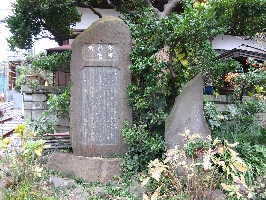
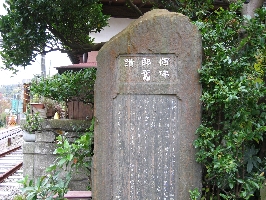
Location: Go down the slope toward Shichirigahama Beach from Gokurakujizaka Slope, passing Gokurakuji Station on the Enoden Line, turn to the right, cross the tracks of the same line, and you will be in Tsukikagegayatsu. Just beyond the crossing is a stone monument that marks the former site of the dwelling where Abutsu Ni (阿仏尼, ?-1283), a nun, once lived.
Story: Abutsu Ni is the author of Izayoi Nikki (十六夜日記), "Diary of the Waning Moon," written in the Kamakura period. Before becoming a nun, she was a poet and the wife of Fujiwara no Tameie (藤原為家, 1198-1275), the son of Fujiwara no Sadaie or, popularly, Teika (藤原定家, 1162-1241), a noted poet.
She was also the mother of Fujiwara no Tamesuke (藤原為相, a.k.a. Reizei Tamesuke, 冷泉為相, 1263-1328) who became the founder of the Reizei branch of the Fujiwara family.
Tameie had another son, Tameuji (為氏), by a former wife, and when Tameie died, a dispute over inheritance broke out. Abutsu was living in Kyoto at the time and decided to bring the case before a court of law in Kamakura, thus had to journey here all the way from Kyoto in 1277.
It was during this journey and sojourn in Kamakura that she wrote the above-mentioned diary. She stayed in this valley four years while her case was under consideration. The monument says that she died here, but another story says that she died in Kyoto. A stone monument to honor her memory was erected in a cave near Eishoji Temple (英勝寺) in Ogigayatsu (扇ガ谷).
Abutsu's son, Reizei Tamesuke, came here from Kyoto soon after his mother arrived, and lived near Jokomyoji Temple (浄光明寺) in Ogigayatsu. He later became middle counselor in the imperial court in Kyoto, and left many collections of waka poems.
| Harisuribashi Bridge (針磨橋) |
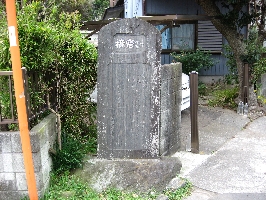
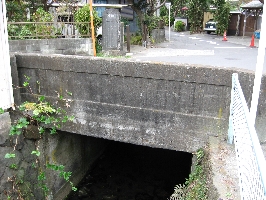
Location: From the entrance to Tsukikagegayatsu Valley, you will need to walk down toward Inamuragasaki Cape. On the way, you will pass a bridge called Harisuribashi, so short that it could easily be overlooked, although it was once one of the ten famous bridges of old Kamakura.
Story: A stone monument identifies the bridge. There is a story that says an old woman who made her living by re-sharpening used needles once lived here.
In those days, jobs of that kind were regarded as useful because needles were far more expensive than now.
However, another story asserts that it was a priest, Ganyudo (我入道), at a sub-temple of Gokurakuji, who did such work. In either case, the area near the beach had the name Kanayama (金山), "Metal Hill," and a nearby beach produced abundant iron sand of good quality. It is assumed that in those days the iron was collected as raw material for the production of ironware.